
People across Andover hoping to catch tonight’s spectacular partial solar eclipse are being urged to protect not only their eyesight – but their smartphones too – as demand for specialist eclipse glasses leaves supplies increasingly difficult to find.
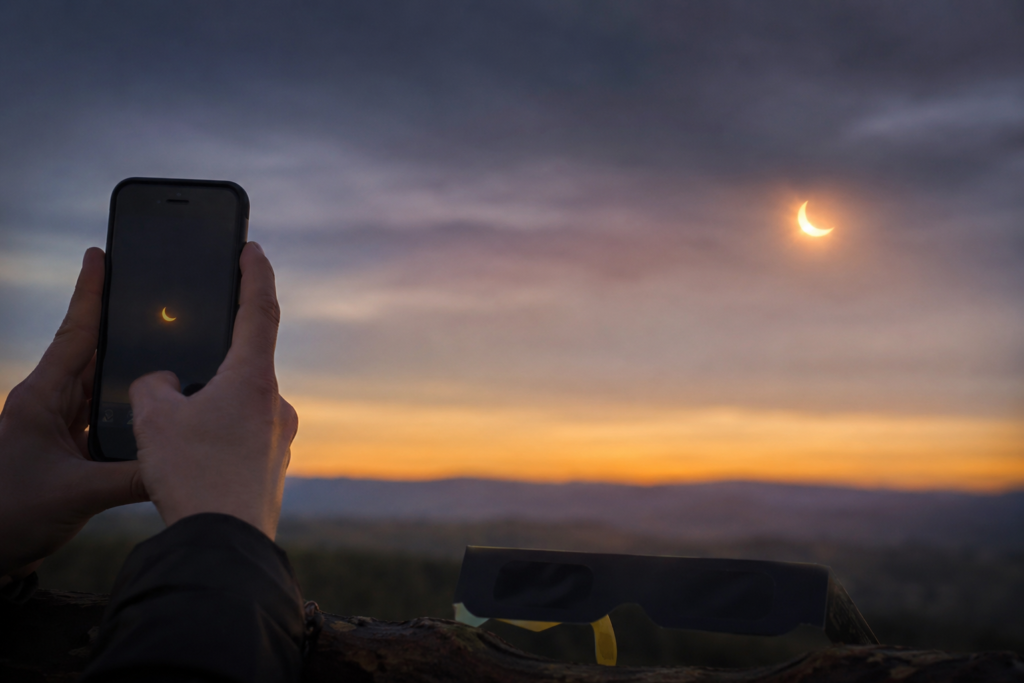
The eclipse takes place this evening, Wednesday 12th August, when the Moon will pass between the Earth and Sun and cover more than 90 per cent of the solar disc across much of southern England.
For Andover and the surrounding Hampshire area, the spectacle will begin shortly after 6.15pm, with the eclipse reaching its maximum at approximately 7.14pm, before coming to an end shortly after 8pm.
Nearby Southampton is expected to see around 92.55 per cent of the Sun obscured, with the eclipse beginning at 6.18pm, reaching maximum at 7.14pm and ending at 8.07pm. Further west, the proportion of the Sun covered increases slightly, with Bournemouth reaching around 94 per cent.
That means, weather permitting, residents in Andover should be treated to one of the most impressive astronomical sights visible from Britain for years.
However, there is an important warning for anyone who has left it until eclipse day to find suitable eye protection.
Eclipse glasses becoming difficult to find
Specialist eclipse glasses have reportedly been selling rapidly ahead of the event, leaving some reputable retailers without stock and potentially tempting people to find alternative ways of watching.
Normal sunglasses – regardless of how dark they are – must not be used to look directly at the Sun.
The Royal Astronomical Society recommends safe indirect methods of viewing an eclipse, including projecting an image of the Sun using simple household objects. A kitchen colander can create multiple projected images of the partially eclipsed Sun, while two pieces of card or paper and a small pinhole can be used to make a basic solar projector.
Anyone using eclipse glasses should ensure they are specifically designed for solar viewing and are undamaged.
Don’t assume your phone will protect you
With eclipse glasses becoming harder to obtain, some people may be tempted to simply hold up their smartphone and watch the eclipse through the screen.
While that avoids staring directly at the Sun, experts are warning that it creates another potential problem.
Pointing an unprotected smartphone camera directly at the Sun for a prolonged period can risk damaging the camera sensor.
Jez Samuel, mobiles expert at Uswitch, said: “Many will pick up their phone to look at throughout Wednesday’s eclipse – but the camera lens needs protecting.”
He explained that a smartphone camera lens concentrates sunlight onto the sensor behind it. Sufficient exposure to intense, unfiltered sunlight can permanently damage pixels, potentially leaving marks appearing in future photographs.
According to Uswitch, repairs could range from around £40 for replacement camera glass to more than £250 where an entire camera module needs replacing, depending on the handset.
Those determined to photograph the event are advised to use a purpose-designed solar filter fitted securely over the camera lens, rather than simply pointing an unprotected phone towards the Sun.
No glasses? You can still watch
Missing out on eclipse glasses does not mean Andover residents have to miss the event entirely.
One of the easiest options is a pinhole projector. A tiny hole in a piece of card can be used to project an image of the Sun onto another surface behind it. The observer looks at the projection – not through the hole at the Sun.
Even something as simple as the holes in a kitchen colander can project numerous crescent-shaped images during the partial eclipse.
Alternatively, the eclipse can be followed through a reputable livestream or television broadcast.
The key rule remains simple: never look directly at the Sun without appropriate solar viewing protection. Timeanddate also warns that direct observation without proper eye protection can cause serious eye injury.
Binoculars, telescopes and camera lenses should also never be pointed towards the Sun for viewing unless fitted with a correctly designed solar filter at the front of the instrument. Eclipse glasses alone are not sufficient protection when looking through magnifying optical equipment.
Andover should get an impressive show
Although tonight’s event is a total solar eclipse globally, Andover and the rest of the UK sit outside the path of totality, meaning residents will experience a deep partial eclipse instead.
Across England, the partial phase begins from around 6.09pm, with the final stages disappearing shortly after 8pm.
The Hampshire figures give an idea of just how dramatic it could become. Southampton is predicted to reach 92.55 per cent obscuration, while Portsmouth will reach maximum eclipse at around 7.14pm.
For Andover, finding somewhere with a clear view towards the western sky will be particularly important because the Sun will already be relatively low during the evening event. Open countryside and locations without buildings or trees blocking the western horizon should provide the best opportunity, subject to cloud conditions.
And despite the temptation to capture every second for social media, Samuel has suggested there might be something to be said for putting the technology away once the obligatory photograph has been taken.
“Once you’ve got it, you might even want to put the phone back in your pocket for a few minutes and enjoy the moment,” he said.
For Andover residents fortunate enough to have certified eclipse glasses and clear skies, that may prove to be the best advice of all.
Tonight’s eclipse is a rare opportunity to watch the familiar evening Sun transform into a dramatic crescent above Hampshire – but whether viewing it through certified protection or by projection, keeping eyes safe must come before getting the perfect picture.