
This article is written by David Wybrow, who each month will be delving into the rich and often surprising history of Andover’s local pubs. Through careful research and storytelling, David will explore the buildings, people and events that have shaped these much-loved establishments over the centuries.
It is only fitting that this series begins with Andover’s oldest public house — The Angel — a landmark steeped in over 600 years of history and firmly woven into the town’s story.
The Angel Inn is Andover’s oldest and most historic public house, standing proudly and distinguished at the top of Andover High Street. The previous inn, along with the current building, was constructed between 1444 and 1455 and was owned by Winchester College, which also owned several other buildings around the town. Winchester College was founded in 1382 by William of Wykeham, with construction of its buildings beginning that year. The college opened its doors to its first scholars on 28 March 1394. As a method of securing income and funding for future projects, the college built and purchased properties in local towns for rental purposes.
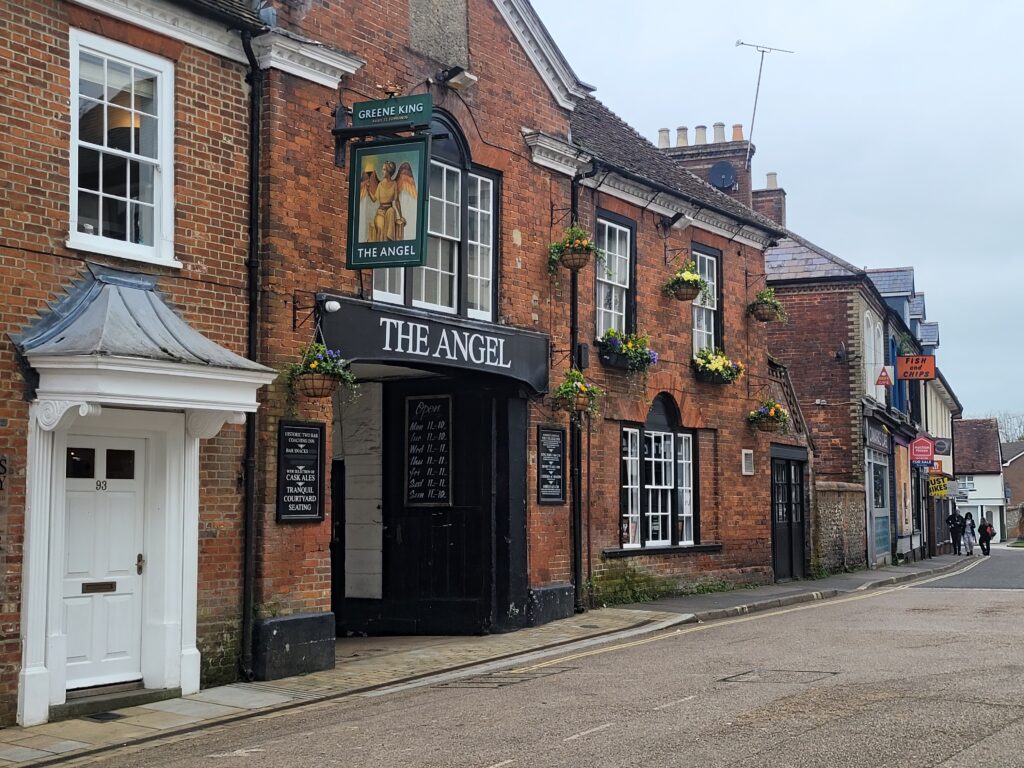
Winchester College is known to have built at least one other inn, in 1418, also called The Angel, on the main market street in New Alresford. That pub is now called The George and underwent a name change in 1415 to celebrate King Henry V and his men at the Battle of Agincourt. The Angel Inn in Andover was constructed as a timber-framed inn arranged around a central courtyard.
The timber for the construction was carted from woodland near Kingsclere, while Beer stone was quarried in Devon. A total of 20,000 bricks—probably used for nogging (the technique of filling gaps in a wooden frame with brick, known as brick nogging)—were purchased from Daniel Brykeman. The windows were fashioned from Caen stone carted from Botley. Sixty oak trees were felled for timber from Chute, Wiltshire. Two stonemasons, Thomas Beere and John Cotyn, were engaged to build the chimney stacks and fireplaces, and to line the cellars and latrine pits (a type of toilet that collects human waste in a hole in the ground).
The detailed plans were originally drawn up by John Harding but were subsequently modified by Robert Wheteley, Warden of Carpenters to Henry VI at Eton College, Windsor. One of the final acts was the painting of the inn’s sign, which was made by John Massyngham at Winchester in 1452. The Angel cost £400 to build, and three houses were also built adjacent to the site. The pub was designated as a Grade II listed building on 24 February 1950.
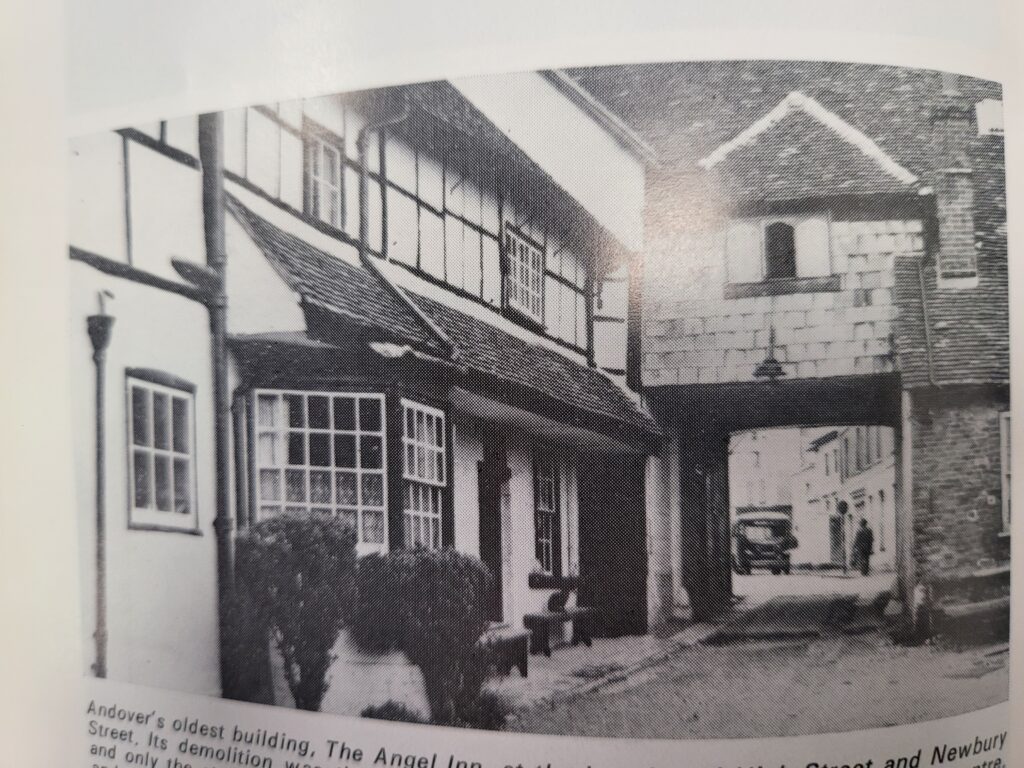
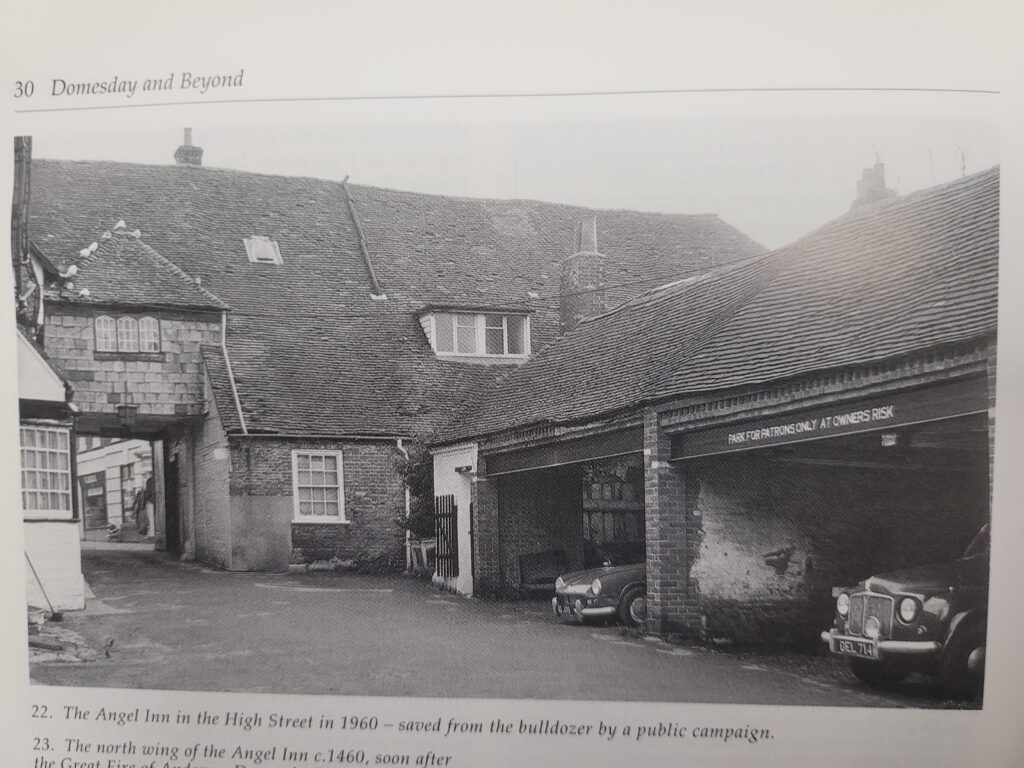
The original buildings ran down the High Street as far as the premises once owned by the Butters Café. Detailed information, still kept by Winchester College, is based on a 1445 contract commissioned by Robert Thurbern, the Warden of Winchester College. On 4 March 1445, he contracted two carpenters—John Harding and Richard Harnest—to construct a timber-framed inn on a void site that had been formed following the Great Fire of Andover in 1434. Unsubstantiated reports suggest that the fire, which passed through the town at great speed causing untold damage, is believed to have started in a butcher’s shop situated in White Bear Yard in the High Street. The inn’s first landlord was Robert Cusse, who ran the popular hostelry from 1456 to 1461.
The Angel Inn has played host to many distinguished guests during its fascinating 600-year history, including royalty. King John, who gave the borough its first charter in 1201, is reported to have stayed at the hostelry, and there is still a “King’s Door” to commemorate the occasion. Both Edward I and Edward II used the inn, and later Henry VII “rested” there after suppressing the famous rebellion by Perkin Warbeck, a Flemish imposter who claimed to be Richard of Shrewsbury, Duke of York, one of the “Princes in the Tower.” Warbeck was executed in 1499 for his conspiracy against Henry VII.
Catherine of Aragon landed at Plymouth in 1501 with the intention of becoming the bride of Prince Arthur, Prince of Wales, who died in 1502. She eventually married his younger brother Henry in 1509. The marriage lasted until it was annulled in 1533, and Catherine of Aragon died on 7 January 1536.
It is also said by local historians that James II stayed at the inn while fleeing from William of Orange, although this has never been confirmed. It is, however, known that James II drank at the pub with Prince George and the Duke of Ormond while travelling from Plymouth to London.
In April 1642, Mrs Marie Pope, the innholder of The Angel—then considered to be the premier hostelry of the town—was one of 28 licensees fined 20d for “not selling the best beer for one penny,” an offence committed quite regularly in the 17th century. Mrs Pope was the grandmother of the famous poet Alexander Pope. The poet’s father, also named Alexander Pope, was born at the inn posthumously in 1646. He was baptised at St Mary’s Church in Andover on 22 April of the same year. He was the son of Alexander Pope, Rector of Thruxton, and Dorothy Pine.
Before 1793, The Angel was leased from Winchester College by the resident innkeeper, but in that year Charles Heath of the London Street Brewery became the lessee. The Heath family continued to hold the lease until 1847, when the brewery was sold. The leasehold reverted to innkeeper John Penfold in 1849, but ten years later John Poore, another local brewer, signed a new lease, renewing it again in 1869. In 1920, John Poore’s son, Philip Henry Poore, then aged 88, bought both The Angel and The Silent Man at 90 High Street, Andover.
As one of Andover’s oldest and best-loved buildings, The Angel at one point played a major role in the day-to-day lives of the local population. The hostelry was used as Andover’s Guildhall during its rebuilding from January 1825 to June 1826. Andover Borough Council decided that the large front room—better known as the Market Room, and now the public bar—should be the temporary “Guildhall” during this time. Councils, assemblies, magistrates’ and coroners’ courts were also held there over this period.
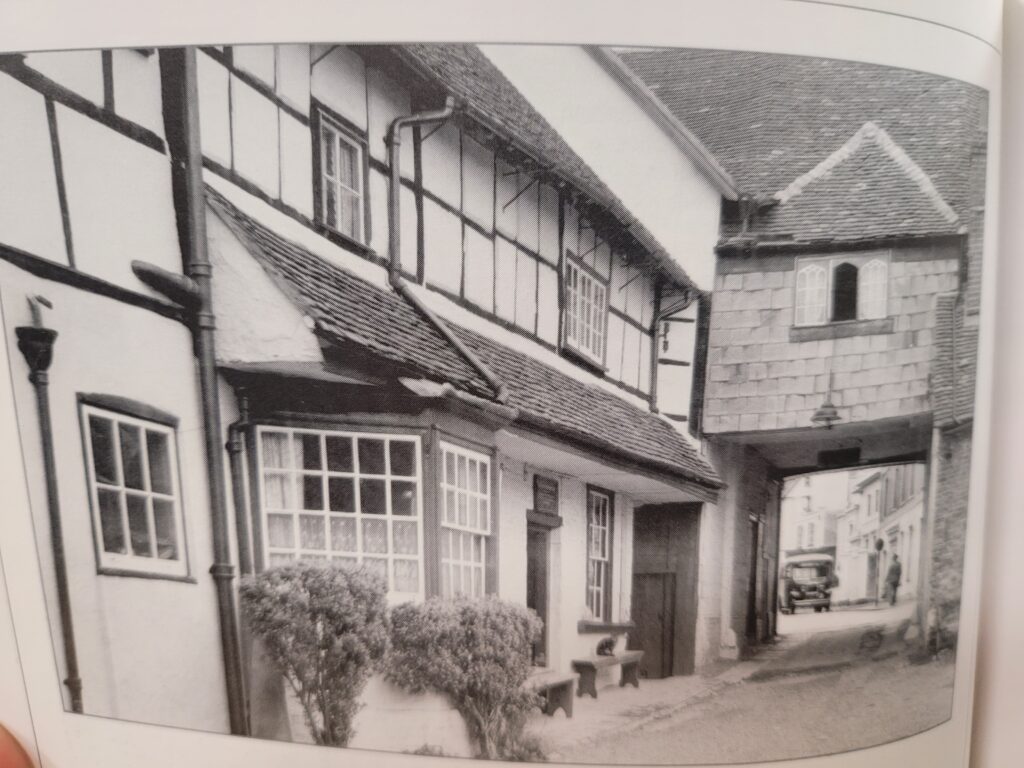
In 1961, the first plans for a new shopping centre were published to meet the needs of the planned expansion of the town via the agreed “London overspill.” The proposed plan earmarked The Angel for demolition. As the pub was considered to be one of the town’s oldest and much-loved buildings, the proposal met with fierce opposition. In March 1965, Councillor Martin Loveridge, who owned a very successful tailoring business in Swan Court and later the High Street, launched a “Save The Angel” campaign. During the campaign it was suggested that the building should become a local museum or be taken down and rebuilt elsewhere.
Within a fortnight, a petition was organised as part of the former mayor’s campaign, attracting over 3,000 signatures from across the country. In October 1965, it was announced that government expenditure was to be cut and national development plans must be deferred by local councils. By November 1966, a curtailed scheme for the new Chantry Way shopping centre was presented, with the revised floor area for the new shops reduced to half the original plan. When a revised town centre plan emerged in 1967—slashing the overall size from a £4 million scheme to one of £2.5 million—The Angel was not included in the redevelopment area. Andover’s oldest and most cherished building had finally been saved, thanks to public support and a lack of government budget.
In 1968, Richard Warmington of Andover, a former Andover Grammar School pupil and then a 19-year-old architecture student, produced a complete reconstruction of The Angel exactly as it had looked when rebuilt in 1445, following a former inn on the same site, which was also owned by Winchester College. His detailed reconstruction demonstrated that the inn was twice its present size, with buildings forming a complete square around a central courtyard. Running around the building was a gallery at first-floor level, open to the courtyard on all four sides.
Today, The Angel remains a proud symbol of Andover’s heritage, standing as a reminder of the town’s resilience, character and rich past. From royal visits and historic events to community campaigns that saved it from demolition, its story is one that continues to evolve. As this series unfolds, we will uncover more of the fascinating histories behind Andover’s pubs — but few can rival the depth and significance of The Angel, a true cornerstone of the town’s identity.