
This article is written by David Wybrow, who will be delving into the rich and often surprising history of Andover’s local pubs. Through careful research and storytelling, David will explore the buildings, people and events that have shaped these much-loved establishments over the centuries.
Although The Redbridge is one of Andover’s more modern pubs, the site on which it stands has a history stretching back more than 400 years, encompassing coaching inns, drapers, department stores and one of the town’s most significant commercial buildings.
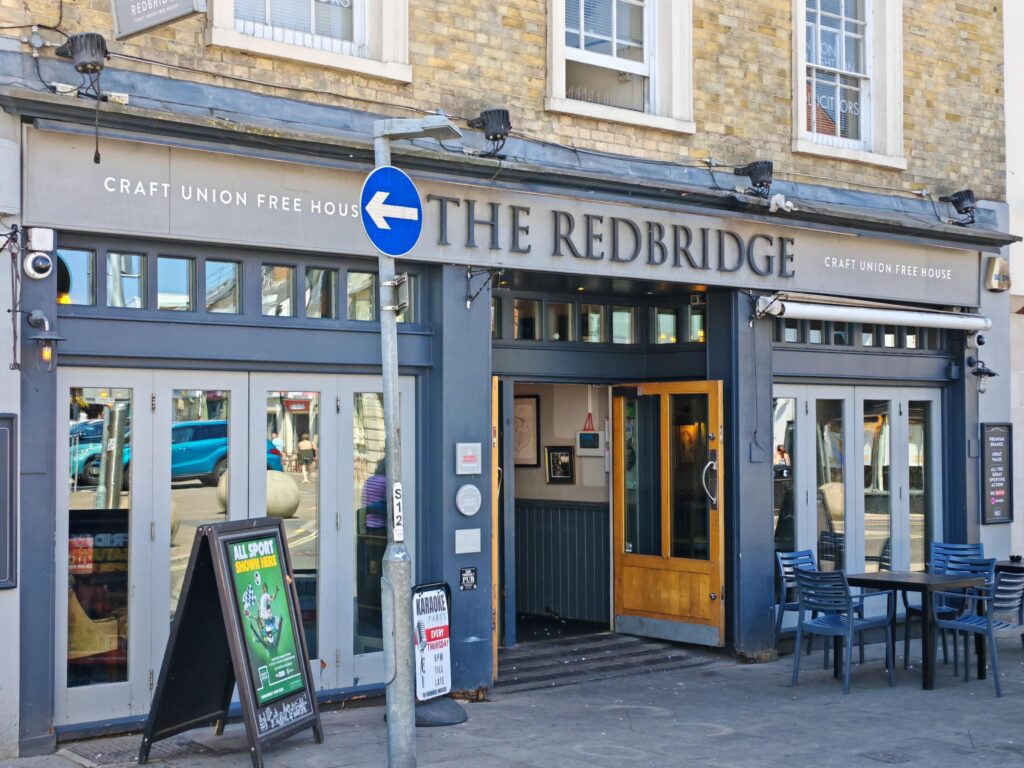

The Redbridge officially opened its doors on 27 April 2005 as the latest venue operated by the Barracuda Group. Its name was chosen following a competition run in the Andover Advertiser, with local resident Darren Kidd submitting the winning entry from around 40 suggestions. His choice was selected because it celebrated an important part of Andover’s heritage – the Redbridge Canal, which operated between 1793 and around 1861.
Although the pub is relatively new, the history of the site reaches much further back. The present building appears to date from the early 19th century, but an earlier structure occupied the same location. It was known as The Three Choughs Inn, sometimes referred to simply as “The Choughs” or “Ye Choffs”, and is recorded in documents dating back to 1624.
The inn was owned by Walter Lake, who borrowed £100 from his sister-in-law, Mary Lawrence, to finance the property after marrying Martha Lawrence in 1738. Lake also owned the neighbouring premises, built in 1747 on the site of an even earlier public house known as The Ship Inn.
Following Walter Lake’s death in 1809, the property passed through a succession of owners. One of the final landlords of The Three Choughs Inn was John Cockrum, who renamed it The Three Blackbirds before 1792. Advertisements suggest the old inn may eventually have been demolished in 1827.
The site then entered a new chapter when it became home to a drapery business. Edward Bishop Hawkins, born in Cranford, Middlesex, in 1806, was running the business by 1841. Over the following decades the company traded under several names, including Hawkins & Son, Hawkins & Clarke, and Clarke & Harris, before eventually becoming the business of William Percival Clarke.
Clarke developed one of Andover’s leading outfitters and house furnishing stores, operating from 7 Bridge Street for around half a century. The business was later acquired by the Southampton-based drapery firm Plummer Roddis, which was expanding rapidly across the south of England during the early 20th century. By 1928, the company had become part of the Debenhams organisation, while Plummer Roddis itself had achieved national recognition, even receiving a mention in H.G. Wells’ 1905 novel Kipps: The Story of a Simple Soul.
Plummer Roddis occupied the Andover premises from 1942 after the Debenhams organisation purchased the business. The company took over the prestigious premises from William Percival Clarke, who had also served as Mayor of Andover in 1913 and 1914.
The department store expanded across several buildings around the Bridge Street and Winchester Street area. Among its departments was a children’s clothing shop in what is now occupied by Chilli’s Restaurant, while another neighbouring premises had previously housed Moyce & Son, butchers in Andover from 1888 until 1968. The company also operated a popular millinery department selling ladies’ hats and even offered a stocking repair service, reflecting the level of customer service expected during the period.
The early 1970s brought dramatic change. Debenhams proposed purchasing the surrounding properties to create a larger modern department store, but the plans were rejected by Andover Borough Council. The store was consequently marked for closure in January 1973.
The premises were subsequently taken over by FADS (Furniture and Design Studio), which retained the original Bridge Street frontage, including its distinctive recessed entrance and large display windows. During the company’s occupation, another fascinating piece of Andover’s history came to light.
In July 1979, FADS manager Bill Legge discovered copies of The Times dating from 1856 hidden beneath wallpaper while converting an upstairs room into a staff room. Further investigation revealed original wooden panelling dating back to the days when the building had served as one of Andover’s coaching inns. The Victorian decorators had stretched hessian across the panelling before pasting newspapers over it and finally applying wallpaper.
Recognising the historical significance of the find, Mr Legge chose not to expose the early 17th-century panelling permanently, remarking that it should instead remain hidden to be rediscovered by a future generation.
FADS later relocated to the newly developed Enham Retail Park on Newbury Road during the late 1990s. The Bridge Street premises subsequently became home to Roseby’s Furnishings, before being acquired by discount retailer Bargain Box, which remodelled the shopfront by removing its original recessed entrance and display windows.
In 2005, the building entered another new era when it was purchased by the Barracuda Group, which transformed the premises into The Redbridge. The pub later became part of the Smith & Jones chain before joining the Craft Union family.
Today, customers enjoying a drink in The Redbridge are standing on a site whose story stretches from a 17th-century coaching inn and the age of canals, through centuries of retail history, to one of Andover’s most recognisable modern pubs. It is a reminder that behind many of the town’s familiar buildings lies a remarkable history waiting to be rediscovered.
This article is based on research and handwritten notes by local historian David Wybrow
What an amazing write up, really fascinating reading. Love this, can’t wait for the next one!
Cheers Paul. Appreciate the feedback. David does a lot of research. He did one back in April on the Angel – go check it out.
https://loveandover.com/pubs-of-andover-the-story-of-the-angel-inn/